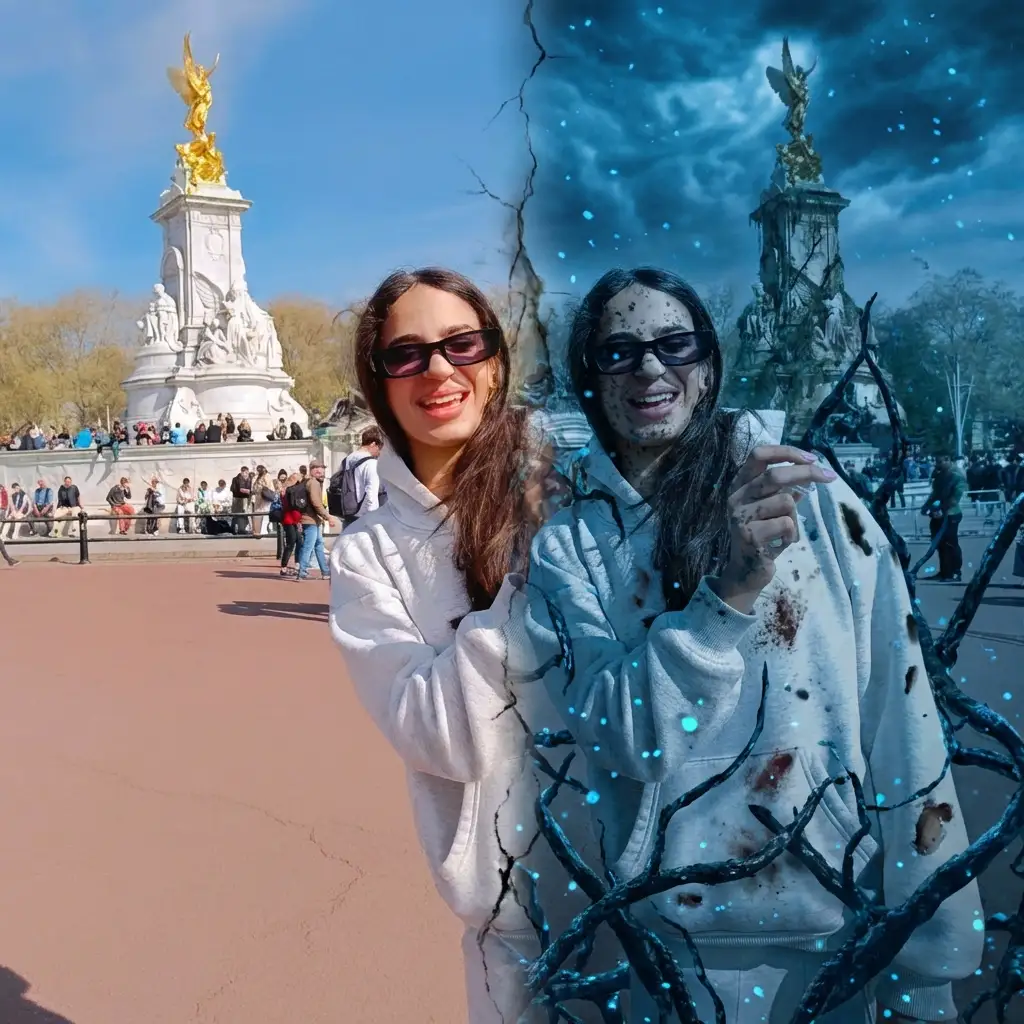
Split composition showing person transitioning between normal Hawkins and Upside Down dimension of Stranger Things. Left side normal colorful world, right side dark decayed mirror version. Vines and particles. Cold vs warm lighting. Reality distortion effect.
About this style
The Split Dimension aesthetic captures one of the most iconic visual concepts from the Stranger Things universe: the jarring contrast between the ordinary town of Hawkins and its nightmarish parallel dimension known as the Upside Down. This style creates a dramatic before-and-after or reality-versus-nightmare composition where a single subject exists simultaneously in both worlds, typically divided down the middle of the frame.
The technique draws inspiration from the show's masterful use of atmospheric lighting and environmental storytelling, where the same locations appear both comfortingly familiar and terrifyingly corrupted. The visual language relies heavily on color temperature opposition, with warm golden tones and vibrant colors representing the real world while cold blues, sickly greens, and desaturated palettes dominate the Upside Down side.
This prompt style works exceptionally well for creating dramatic character portraits, storytelling images, or conceptual art that explores themes of duality, corruption, and parallel realities.
Content creators, fan artists, and social media enthusiasts often use this aesthetic to generate eye-catching images that immediately communicate transformation or the presence of hidden darkness. For best results, be specific about the transition point and ensure your prompt clearly describes the environmental differences between both sides, including details like the presence of floating particles, organic vines creeping across surfaces, and the degree of decay on the Upside Down side. Adding descriptors about the distortion effect at the boundary between worlds helps create that signature reality-warping visual that makes the composition more dynamic.
Both Gemini Image Pro and OpenAI 4o handle this style remarkably well, with Gemini often excelling at the organic, vine-covered textures and atmospheric particle effects while OpenAI 4o tends to produce sharper contrast between the two dimensional sides and more precise compositional splits.