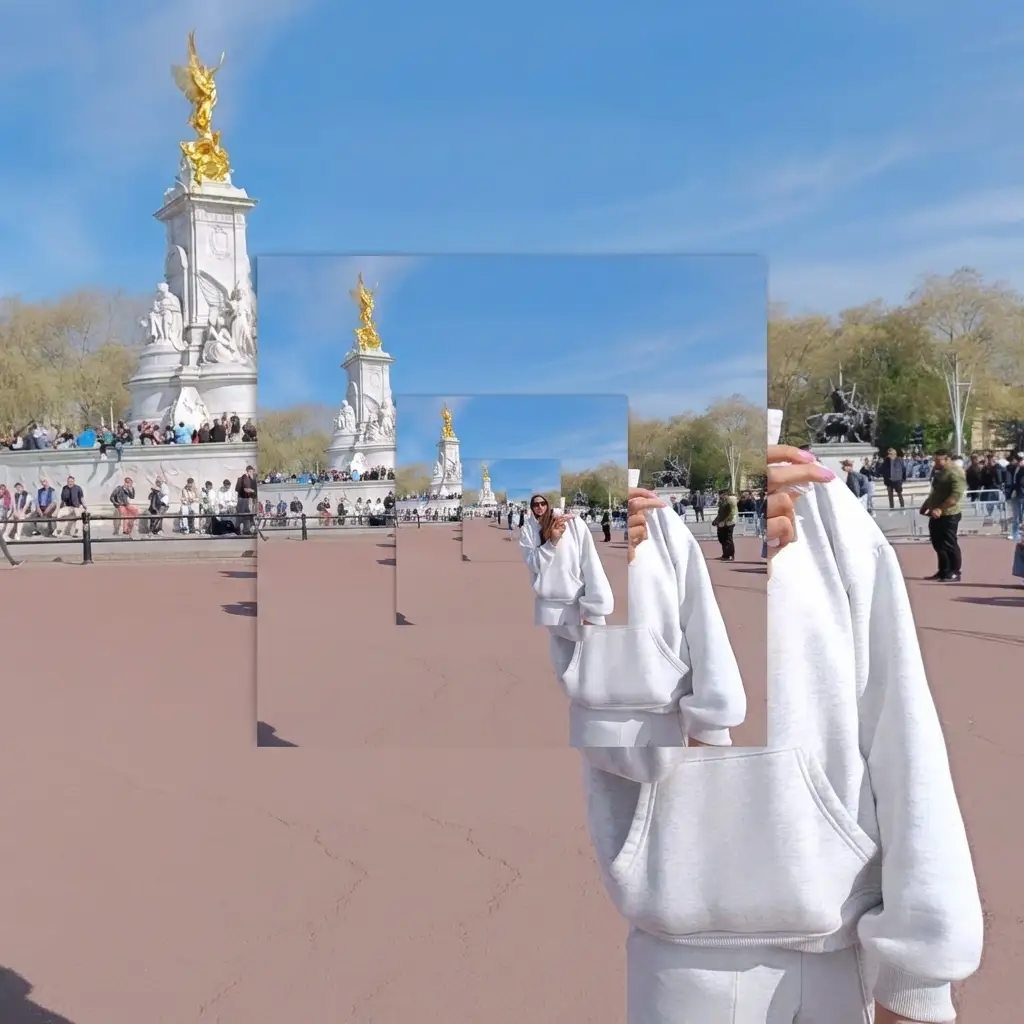
Droste effect recursive infinite loop image, the scene contains a smaller version of itself repeating inward, mind-bending recursive composition, mathematically precise spiral repetition
About this style
The Recursive or Droste Effect creates mesmerizing images where a picture contains itself in an infinite, spiraling loop, named after the famous Dutch cocoa brand whose packaging showed a woman holding the same package in an endless repetition. This mathematical phenomenon transforms ordinary scenes into mind-bending visual puzzles where viewers can follow the image inward through progressively smaller iterations, creating a tunnel-like effect that challenges perception and draws the eye into seemingly impossible depths.
The effect has fascinated artists and mathematicians since M.C. Escher popularized recursive imagery in the mid-20th century, and it remains a powerful tool for creating surreal, attention-grabbing visuals that feel both hypnotic and intellectually stimulating.
This style works particularly well for advertising, album covers, conceptual art, and any project seeking to convey themes of infinity, self-reference, or cyclical patterns. For best results, choose subjects with clear focal points like picture frames, mirrors, screens, or hands holding objects, as these natural "containers" help guide the recursive spiral and make the effect more comprehensible. The composition should have strong contrast and distinctive elements that remain recognizable even when scaled down, avoiding overly complex backgrounds that might become muddy in smaller iterations.
Both Gemini Image Pro and OpenAI 4o handle this effect admirably, though you may need to emphasize terms like "mathematically precise" and "infinite spiral" to achieve clean, well-defined recursions rather than chaotic repetitions. Experimenting with different center points and specifying the direction of the spiral (inward versus outward) can yield dramatically different results and help you fine-tune the visual impact.